
Understanding the various natural ingredients for skincare feels never ending.
But pecan oil is truly an unsung hero of the beauty world – not because it’s revolutionary, but because it does what good skincare should do and that’s work well.
Table of Contents
why pecan oil…
The skincare industry eternally stays obsessed with its hero oils.
We’ve all tried argan oil, rose hip, aloe vera, coconut oil, and many others, year after year.
Pecan oil for skin hasn’t had that moment yet, which honestly works in its favor. At the very least, pecan oil could be a pretty convincing placebo in an overhyped and saturated skincare landscape.
Pecan oil sits somewhere between 60-70% oleic acid (depending on the source), with a solid amount of linoleic acid.
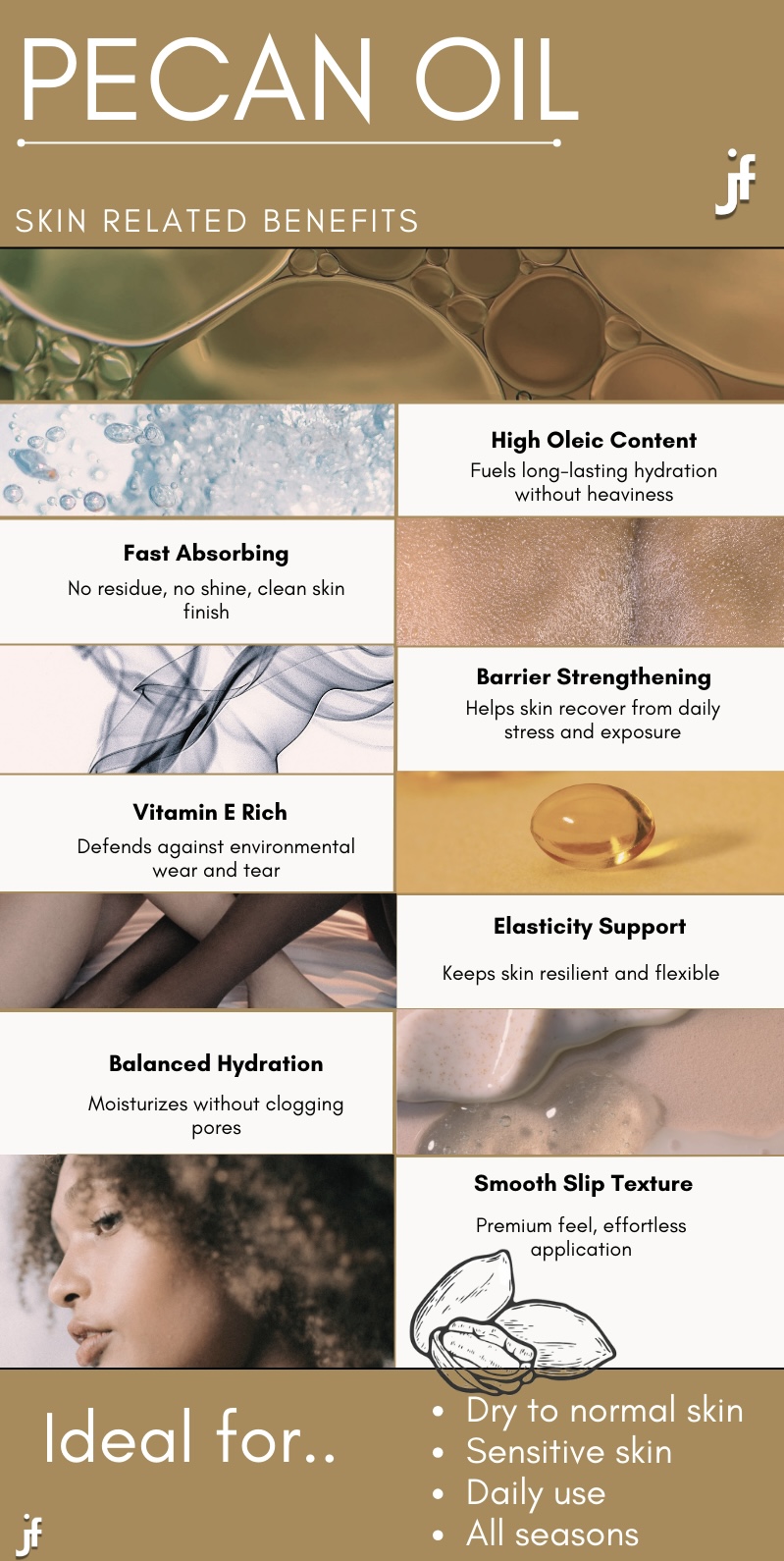
Skin barrier functions reveal oleic acid to be deeply moisturizing but heavy feeling. Linoleic acid is lighter and helps regulate oil production. Together, they create an oil that hydrates without that thick, occlusive feeling that makes some people avoid facial oils entirely.
cold pressed pecan oil benefits for skin
Pecan oil moisturizes effectively across different skin types.
The oleic-linoleic balance makes it workable for people with normal to dry skin, and even some with combination skin find it doesn’t trigger excess oil production the way purely oleic-rich oils can.
The vitamin E content is legitimately high.
We’re talking about tocopherols and tocotrienols – different forms of vitamin E that function as antioxidants. This isn’t marketing speak; vitamin E helps neutralize free radicals that contribute to premature aging and supports skin barrier repair.
It absorbs without leaving a heavy film.
This was the thing that surprised me most when I first tested it. Despite being fairly rich in oleic acid, properly processed pecan oil doesn’t sit on the skin the way some oils do. I suspect this has to do with its overall composition and molecular weight, though I haven’t seen formal research on this specific point.
It’s non-comedogenic for most people.
With a comedogenic rating around 2 out of 5, it’s less likely to clog pores than coconut oil or wheat germ oil. That said, everyone’s skin is different – patch testing remains essential.
the oils compared.
If you’re already using facial oils, here’s how pecan oil stacks up:
| Argan Oil | Jojoba Oil | Rosehip Oil |
| – similar fatty acid profile | – wax ester, not oil | – higher linoleic acid |
| – heavier texture | – mimics skin’s sebum | – great for oily-acne prone |
| – slower absorption | – less moisturizing | – regenerative properties |
| – more researched for skin | – regulates oil production | -less rich, hydrating |
READ MORE : TURMERIC FOR SKIN………
ways to use pecan oil, practically.
Quality ingredients don’t require complexity. Less will always be more. Minimalism keeps you closer to you.
As a straight moisturizer: After cleansing, apply 3-4 drops to damp skin. The water helps it spread and absorb. This works especially well at night.
Mixed into your existing moisturizer: Add 1-2 drops to your regular cream or lotion in your palm before applying. This boosts hydration without completely changing your routine.
For targeted dry areas: Elbows, knees, cuticles – anywhere that gets consistently dry benefits from a small amount of pecan oil. It’s more elegant than petroleum jelly and actually nourishing.
As a cleansing oil component: If you oil cleanse, pecan oil works well mixed with a lighter oil like grapeseed. The oleic acid helps break down makeup and sunscreen, while the linoleic acid keeps it from feeling too heavy.
pecan oil for skin when shopping
so you’ve decided to buy pecan oil for skin and now need to be aware of what to look for when purchasing and how to maintain pecan oil at home.
Expeller-pressed or cold-pressed: This means mechanical extraction without chemical solvents. The oil retains more of its natural vitamin E and antioxidant content this way.
Storage and freshness: Nut oils oxidize over time, especially once opened. Buy from sources with good turnover, store it in a cool dark place (refrigeration extends shelf life), and use it within six months of opening.
Color and smell: Good pecan oil should be golden and smell mildly nutty, not rancid or overly processed. If it smells off or looks cloudy (unless it’s been refrigerated – some oils solidify when cold), don’t use it on your skin.]
READ MORE: IS PECAN OIL TIGHTENING FOR THE SKIN?
what pecan oil doesn’t do
Pecan oil for skin is a good moisturizing oil with solid antioxidant content.
It’s not going to erase wrinkles, cure acne, or replace your retinoid. What it does do is support your skin barrier, provide lasting hydration, and feel pleasant to use – which is actually enough.
If you have a tree nut allergy, obviously avoid it.
And if you’re dealing with specific skin conditions like cystic acne or rosacea, work with a dermatologist rather than trying to DIY with any oil, pecan or otherwise.
why I like pecan oil.
Working with pecans daily gave me easy access to fresh, quality pecan oil, and my skin genuinely responded well to it. I use it most nights, either alone or mixed with a basic ceramide cream. My skin runs normal to dry, and I appreciate that it gives me the moisture I need without feeling like I’ve slathered myself in grease.
There’s also something satisfying about using an ingredient I understand from seed to bottle – knowing the pecans were grown regionally, processed minimally, and turned into something both functional and pleasant to use. That might not matter to everyone, but it matters to me.
if you only take one thing from this
Pecan oil isn’t going to address every skincare concern and you shouldn’t want it to. This oil serves as a strong act of self care and improved texture over vanity.
The barrier-supporting fatty acids and vitamin E content make it genuinely useful, and the texture makes it easy to incorporate into what you’re already doing.
For me, the best skincare has always been about finding ingredients that work consistently without hype. Pecan oil does that.